
AMH (Anti-Mullerian Hormone) Test
Our AMH blood test checks your ovarian reserve. Useful for women going through IVF treatment.
1 Biomarker
£99
31 mins read
Anti-Müllerian Hormone (AMH) is a hormone produced by the small, early-growing follicles in your ovaries, and in the testes in men. Those follicles are continually recruited from the much larger pool of resting eggs you still hold, so measuring AMH gives the closest estimate available from a blood test of your ovarian reserve, meaning how many eggs you have left rather than how healthy those eggs are. It is measured from a single blood sample that can be taken on any day of your cycle, and it is used to assess ovarian reserve before IVF or egg freezing, to help make sense of changes in your periods, and when raised, to support a diagnosis of PMOS. Using Forth customer test results collected between January 2021 and August 2026 in the UK, this page explains what your AMH result means, what the normal range looks like at each age, what causes a high or low result, and how to get tested.
Written by Dr Thom Phillips
October 14, 2026
| What it is | A hormone made by the small, early-growing follicles in your ovaries, and in the Sertoli cells of the testes in men |
| What it measures | Your ovarian reserve, meaning roughly how many eggs you have left, not their quality |
| Unit used in the UK | pmol/L. Most US research uses ng/mL instead. Multiply ng/mL by 7.14 to convert |
| Typical Forth result | Median 11.2 pmol/L across 796 women, falling from 28.5 pmol/L at 21 to 25, to 3.78 pmol/L at 41 to 45 |
| What counts as normal | There is no single figure. Your result is judged against a range set for your age group |
| How results break down | Around nine in ten Forth results came back normal for that woman’s age. 6.7% were low, 3.4% high |
| When to test | Any day of your cycle, including while you are bleeding |
| What it can’t tell you | Egg quality, whether you will conceive this year, or the date of your menopause |
| Turnaround | Results usually available within two working days of your sample reaching the lab |
Anti-Müllerian hormone, sometimes written as AMH and occasionally still called Müllerian inhibiting substance in older papers, is a protein hormone produced inside the ovaries by the cells that surround your developing eggs. In medical terms it belongs to the transforming growth factor beta family, though the more useful way to think about it is as a signal your ovaries send out about how much reserve they are still carrying.
Its first job happens long before any of this matters to you. In a developing foetus, AMH determines whether the Müllerian ducts go on to form the uterus and fallopian tubes or are broken down so that male reproductive organs can develop instead. That early role is why the hormone got its name, and it is also why AMH is measured in newborns and children in some specialist settings.
After puberty the picture changes. AMH levels in women rise through adolescence, peak somewhere in the mid-twenties and then decline gradually for the rest of the reproductive years until they become undetectable around the menopause. That slow, one-directional curve is precisely what makes AMH useful as a marker.
AMH measures the hormone given off by the follicles that have just started to grow, and from that it estimates how many eggs you have left in total. The link works because those early-growing follicles are drawn steadily from your resting pool, so a bigger reserve keeps more of them in circulation at any moment and produces a higher reading. Nothing in the test counts your resting eggs directly, which is why AMH is best understood as a close proxy rather than a tally.
This is worth being precise about, because the shorthand “AMH measures your fertility” causes a lot of unnecessary distress. AMH is a count, not a quality score. It tells you about quantity of eggs, not their chromosomal health, and it says nothing at all about whether your fallopian tubes are open, whether your uterus is receptive or whether ovulation is happening reliably each month.
In women, AMH is made by the granulosa cells, the layer of cells that wraps around each egg inside its follicle. Production comes almost entirely from the preantral follicles, which are microscopic, and the small antral ones measuring roughly two to ten millimetres, which are the follicles a clinic counts on an ultrasound scan. The truly dormant follicles, the primordial ones that make up the vast bulk of your reserve, produce none at all, and a follicle that grows on towards ovulation switches its production off again.
So AMH is given off during a narrow window in the life of each follicle, and that is exactly what makes it useful. Follicles leave the dormant pool at a rate that tracks how big that pool still is, which is why the hormone works as an indirect read on a reserve nobody can measure directly. The overlap with what a scan can see is the reason the two measures agree so closely, since a blood test and an antral follicle count are largely counting the same group of follicles by different means. It also explains why AMH stays so steady across your cycle: it comes from the follicles you are not using this month rather than the one heading towards release.

AMH comes from follicles that have just begun to grow, not from the dormant ones that make up most of your reserve, which is why it works as an estimate rather than a count.
Ovarian reserve is the term for the pool of eggs you have remaining, and it is a genuinely finite thing. You are born with every egg you will ever have, somewhere in the region of one to two million, and that number falls continuously through childhood and adulthood whether or not you are ovulating.
No blood test can count the dormant follicles themselves, so every measure of ovarian reserve is an estimate. AMH has become the standard blood marker for that reserve because it correlates closely with antral follicle count on ultrasound and because, unlike Follicle Stimulating Hormone (FSH), it does not need to be taken on a specific cycle day to be interpretable. Fertility clinics generally use the two together, alongside a scan, rather than relying on either alone.
The honest limitation is this. Ovarian reserve is about supply, not about outcome. A woman with a modest reserve who ovulates well can conceive readily, and a woman with a generous reserve can struggle for reasons that have nothing to do with egg numbers.
Men produce AMH too, in the Sertoli cells of the testes, and before birth those levels are very high because that is when the hormone is doing its structural work. Concentrations stay elevated through early infancy, decline slowly through childhood and then drop sharply at puberty as testosterone rises.
In adult men AMH is rarely a useful test on its own, which is reflected in how people actually use it. Of the AMH results in our dataset, only one came from a man. Where it does get measured in men, it is usually in specialist paediatric or andrology settings, to confirm the presence of functioning testicular tissue or to investigate conditions such as persistent Müllerian duct syndrome, androgen insensitivity syndrome or congenital hypogonadotropic hypogonadism. If you are a man looking at your hormones more broadly, Testosterone (total) and Sex Hormone Binding Globulin (SHBG) will tell you considerably more.
AMH does not affect your fertility so much as report on one part of it. A low level does not cause difficulty conceiving, and raising it artificially would not make conception easier, because the hormone is a readout rather than a lever.
Where it earns its place is in prediction of a specific kind. In IVF, AMH is one of the best available predictors of how many eggs will be collected after ovarian stimulation, which is why almost every fertility clinic measures it before starting treatment. NICE guidance uses AMH at or below 5.4 pmol/L to flag a likely low response to stimulation, and above 25.0 pmol/L to flag a likely high response. Both figures are about the treatment, not about you.
Research in women undergoing IVF has found that those with higher AMH tend to have more eggs retrieved and better fertilisation and embryo transfer rates. The relationship holds at the population level and blurs considerably at the individual one.
What AMH gives you a is reasonable estimate of egg quantity for your age, a sense of how your reserve compares with other women in the same age bracket and a useful prediction of how your ovaries would respond to stimulation if you went down the IVF or egg freezing route. Tested more than once over several years, it also shows you the direction and pace of your own decline, which is far more informative than any single reading.
What AMH cannot tell you is the quality of your eggs, which is driven mainly by age and for which no blood test exists. It cannot tell you whether you will conceive naturally this year or next. It cannot give you a date for your menopause, only a rough steer on whether you are likely to be earlier or later than average. And it tells you nothing at all about your fallopian tubes, your uterus or your partner’s sperm, which shape your chances every bit as much as egg numbers do.

AMH answers questions about egg quantity and none about egg quality, and knowing which column your question sits in saves a lot of unnecessary worry.
There is no single normal AMH level, and any page that gives you one number is oversimplifying. Your result is assessed against a range set for your age group, because a value that is entirely unremarkable at 42 would be genuinely unusual at 26.
Our laboratory applies six age-specific bands, and the table below shows them alongside their ng/mL equivalents and how many Forth results were assessed against each. When you get your own result, the range printed next to it is the one that applies to you.
| Normal range (pmol/L) | Same range (ng/mL) | Below this is flagged low (pmol/L) |
| 8.7 – 83.6 | 1.22 – 11.71 | 8.7 |
| 6.4 – 70.3 | 0.90 – 9.85 | 6.4 |
| 4.1 – 58.0 | 0.57 – 8.12 | 4.1 |
| 1.1 – 53.5 | 0.15 – 7.49 | 1.1 |
| 0.2 – 39.1 | 0.03 – 5.48 | 0.2 |
| 0.1 – 19.3 | 0.01 – 2.70 | 0.1 |
Forth laboratory reference ranges. Conversion used: 1 ng/mL = 7.14 pmol/L.
Alongside those bands, two numbers from NICE are worth knowing because they appear constantly in fertility conversations. An AMH of 5.4 pmol/L or below suggests a low response to ovarian stimulation, and above 25.0 pmol/L suggests a high one. You will sometimes see these quoted as 0.8 and 3.6 ng/mL rather than the exact arithmetic conversion, which is simply rounding rather than a different standard.
Age is the single strongest influence on AMH, and our own data shows that decline with unusual clarity. Across the whole group the median result was 11.2 pmol/L, but that headline figure hides a steep gradient underneath it.

Bar hart showing median AMH falling from 28.5 pmol/L at 21 to 25 down to 2.0 pmol/L at 46 and over, which is why your result only means something read against your own age group.
| Age group | Median AMH (pmol/L) | Mean AMH (pmol/L) |
| 21 – 25 | 28.5 | 34.21 |
| 26 – 30 | 19.9 | 25.75 |
| 31 – 35 | 15.0 | 19.81 |
| 36 – 40 | 9.15 | 11.75 |
| 41 – 45 | 3.78 | 6.74 |
| 46+ | 2.0 | 4.51 |
| All ages 21+ | 11.2 | 16.75 |
Forth customer data.
The same pattern shows up in published research. One study of 22,920 women found medians of about 17.9 pmol/L at 30, 10.0 at 35 and 3.6 at 40, and our own age brackets follow that curve closely from the late twenties onwards. That study is much larger than ours, though it drew on women attending a hospital and used a different laboratory assay, so the two are not quite like for like. In the Forth data the drop works out at roughly 1.3 pmol/L for every year of age, steepest through the thirties and flattening towards the bottom because there is not much left to lose.
Two things matter when you compare yourself to any of these numbers. The mean sits well above the median in every bracket, pulled up by a few very high results often linked to PCOS, so the median is the fairer figure to measure yourself against. And each bracket covers five years, which means a woman of 31 and a woman of 35 appear in the same row without being expected to return the same number.
A surprising amount of AMH anxiety comes down to arithmetic. You get a UK result of 12, read an American article describing anything under 1.0 as concerning and conclude something alarming, when in fact the two numbers are on completely different scales.
Picomoles per litre is a measure of how many molecules of a substance are present in a given volume of blood. A picomole is a trillionth of a mole, which sounds abstract until you remember that hormones work at genuinely tiny concentrations. UK and most European laboratories report AMH this way, and it is the unit you will see on a Forth report.
The alternative, ng/mL, measures mass rather than molecules. Nanograms per millilitre is standard in the United States and in a large share of the published research, which is why so much of what you read online appears to be using numbers ten times smaller than yours.
The conversion is a single fixed factor. To go from ng/mL to pmol/L you multiply by 7.14, and to go the other way you divide by the same number. Nothing else changes, and no clinical judgement is involved.
| pmol/L | ng/mL | Worth knowing |
| 2.0 | 0.28 | |
| 5.4 | 0.76 | NICE low-response cut-off |
| 9.8 | 1.37 | |
| 12.0 | 1.68 | Close to the Forth median |
| 15.0 | 2.10 | |
| 25.0 | 3.50 | NICE high-response cut-off |
| 40.0 | 5.60 |
Conversion factor used by Forth’s laboratory: 1 ng/mL = 7.14 pmol/L.
One practical caution. Different laboratory assays can produce slightly different AMH values from the same sample, so comparing a result from one provider directly against a result from another is not quite like for like. Retesting with the same laboratory is the cleaner way to track change over time.
You can measure AMH with a straightforward blood test, either through your GP or fertility clinic if there is a clinical reason, or privately if you want the information for your own planning. Because AMH is measured in the liquid part of your blood, you will sometimes see it written as a serum AMH test, which is the same thing.
AMH is a robust measurement, and modern automated assays are reproducible enough that a result you receive from an accredited laboratory can be taken at face value. The question most people really want answered, though, is whether a sample they collect themselves at home holds up against one taken by a phlebotomist. Our own results say it does. Comparing finger-prick samples against venous ones, the two methods produced medians that were effectively identical, 11.7 pmol/L against 11.6 pmol/L, and once the comparison is adjusted for age the gap between them falls below 1%. The classification of those results matched just as closely, with 90.6% of finger-prick samples coming back within range for that woman’s age against 90.2% of venous ones.

Home finger-prick samples returned a median of 11.7 pmol/L against 11.6 for venous ones: how the blood is collected does not change what the laboratory measures.
| Collection method | Median AMH (pmol/L) | Results in range |
| Finger-prick, collected at home | 11.7 | 90.6% |
| Venous sample, taken by a phlebotomist | 11.6 | 90.2% |
Forth customer data, adjusted for age.
That is what you would expect, because the analysis itself is identical whichever way the blood arrived. There are still real reasons a result can read lower or higher than the true picture, and it is better to know them than to be blindsided. Sample handling matters, which is why home tests come with specific instructions about how much blood to collect and how quickly to post it. Assay differences between laboratories mean two providers can return slightly different numbers from the same blood. And some medications and treatments genuinely change what is there to be measured, including chemotherapy and, to a smaller degree, long-term hormonal contraception.
A result that surprises you is worth repeating rather than accepting or dismissing outright. If your number is far from what you expected given your age and your cycle history, a repeat test with the same laboratory a couple of months later will tell you whether you are looking at a genuine finding or a one-off.
The commonest reason is fertility planning of one sort or another. Before IVF or ICSI, AMH helps the clinic choose a stimulation protocol and set expectations about how many eggs are likely to be collected. Before egg freezing it does much the same job, informing how many cycles might be needed.
Beyond treatment, plenty of women test simply because they want information while they still have options open. If you are weighing up whether to try for a baby now or in three years, knowing whether your reserve looks typical for your age or noticeably reduced is a genuinely useful input into that decision.
AMH is also used to investigate a suspected high result in the context of PMOS, to assess ovarian function before chemotherapy or pelvic surgery that could affect the ovaries and to help make sense of very early or unexplained menopausal symptoms.
It tells you where your ovarian reserve sits relative to other women your age, and it gives you a baseline you can measure future results against. Those two things together are the real value, and the second one is easy to underestimate.
A single AMH result is a snapshot taken on one morning of one year. Tested again in two or three years, the same marker tells you the direction and pace of your own decline, which is information no reference range can give you. The trend is where the story actually lives, and it is the reason we built the platform around tracking rather than one-off numbers.
There is no universally right age, though the value of the information changes depending on where you are. In your late twenties and thirties, an AMH result is most useful when you have a decision in front of you, whether that is timing a first pregnancy, considering egg freezing or trying to understand why conception is taking longer than expected.
It becomes clinically important if you are about to start fertility treatment, if you have a family history of early menopause, if you have had ovarian surgery or treatment that could affect your ovaries, or if your periods have changed in a way that suggests your hormones are shifting. NHS advice is to see your GP if you have not conceived after a year of trying, and sooner if you are 36 or over or already know you may have a fertility problem.
Testing very young, with no particular question in mind, tends to generate more anxiety than insight. The number will be high, it will not change your decisions and it will still need repeating when the decisions actually arrive.
Not enough to matter for how you use the result. Studies measuring AMH repeatedly through a cycle do find small, statistically detectable movement, but it follows no consistent pattern from one woman to the next, which is why clinical practice treats AMH as testable on any day. That is a meaningfully different claim from saying AMH never moves, and the distinction is worth keeping. The reason it holds so steady is anatomical. Unlike Oestradiol (Oestrogen), Luteinising Hormone (LH) or Progesterone, all of which rise and fall sharply across a month, AMH comes from a large pool of small follicles that are not taking part in this cycle at all.
Our own results point the same way. Among women who recorded which day of their cycle they tested on, the median AMH was 11.25 pmol/L in the first five days, 10.5 pmol/L between days 15 and 21 and 10.0 pmol/L in the final week. These are different women in each band rather than the same woman sampled repeatedly, so this shows that cycle day does not shift the population picture rather than proving your own level is fixed.

Line chart showing Oestradiol and FSH rising and falling sharply across a cycle while AMH barely moving, which is why it can be tested on any day.
| Cycle day | Median AMH (pmol/L) |
| Days 1 – 5 | 11.25 |
| Days 15 – 21 | 10.5 |
| Days 22 – 28 | 10.0 |
Forth customer data. Bands with fewer than ten results are not shown.
In practice this means you can take an AMH test on any day, including while you are bleeding, which removes one of the more frustrating logistical barriers to hormone testing. If you are testing AMH as part of a wider fertility panel, other markers in that panel may still have a preferred window, and your kit instructions will say so.
Start with the unit, because everything else follows from it. Check whether your report is in pmol/L or ng/mL, and if you are comparing against something you read online, convert before you compare.
Then find the reference range printed beside your result and check that it is the one for your age group rather than a generic band. After that, look at where inside the range you sit. A result of 6 pmol/L in a range that starts at 4.1 is technically normal, but it is sitting near the floor, and that is a different conversation from a result sitting comfortably in the middle.
Last, treat the label as an opening question rather than a closing verdict. Low, normal and high are useful shorthand for where a number falls against a population range, and they were never designed to describe a person.
AMH on its own gives you one column of a much wider spreadsheet. Ovarian reserve is only part of what determines whether conception happens, and several of the most common reversible causes of difficulty sit entirely outside it.
If your questions are less about conception and more about what your hormones are doing across a whole cycle, MyFORM® uses two timed samples to map how your hormones actually behave rather than capturing them once and hoping the timing was right.
Both of the tests below include AMH, analysed in UKAS-accredited laboratories to NHS standards, with results reviewed by our clinical team.
AMH Blood Test: a single-biomarker test for anyone who wants a clear read on their ovarian reserve, whether you are preparing for IVF, considering egg freezing or simply want a baseline you can build on later.
Female Fertility Blood Test: a nine-biomarker panel that places AMH alongside the reproductive and thyroid hormones that shape cycle regularity and conception, for a considerably fuller picture than AMH alone can offer.
Most of the questions we see about AMH come down to the same underlying one, which is what a result outside the expected range actually means for you. A low result is not a diagnosis of infertility and a high result is not a guarantee of an easy conception. AMH is one input into a fuller picture that also includes your age, your other hormones and, if you are having fertility treatment, an ultrasound follicle count.
The first thing worth knowing is how uncommon either outcome is. Across results from women who tested with us, 6.7% came back low and 3.4% came back high, which leaves the overwhelming majority sitting exactly where you would expect for their age.

Nine in ten results came back normal for that woman’s age, so a result outside the expected range is genuinely uncommon.
One thing to be clear about before those percentages travel any further. Each result here was judged against the reference range for that woman’s age, which is why so many land in the normal band. Research that instead applies one fixed cut-off to everybody, commonly 1.2 ng/mL, produces a very different picture, with around a quarter of 30-year-olds and roughly three quarters of 40-year-olds falling below it. Both numbers are correct and they are answering different questions, and mixing them up is the source of a great deal of unnecessary alarm.
The most common cause of a low AMH is simply age, because the pool of follicles producing it shrinks year on year and the decline accelerates through the late thirties. That is not a disease, and framing it as one does nobody any favours.
Beyond age, several things genuinely reduce ovarian reserve:
This is the question that generates the most worry, and it deserves a careful answer. A low AMH in your twenties or early thirties usually reflects one of three things:
Our data adds a detail that surprises most people. Among the women under 30 who tested with us, 12 had a result flagged low, which is 9.8%, and their median result was 6 pmol/L. Younger women are not the least likely group to be flagged low, because each result is judged against the range for that age, and the bar is set higher when you are younger.

A low result is most common at 26 to 30 and least common at 41 to 45, because “low” always means low for your own age.
That table shows how often the label is applied, not how much reserve each group has, and the numbers in the youngest and oldest brackets rest on relatively few tests. Judged against a single fixed threshold instead, the pattern reverses completely and older women come off far worse. The point is that “low” always means low for your age, and the bar sits higher when you are younger.
A low AMH at a young age is a reason to have a proper conversation with your GP or a fertility specialist, and it may change how you plan. It is not, on its own, a diagnosis of anything.
Low AMH itself has no symptoms, which is precisely why it is measured rather than felt. What you may notice are the effects of a declining reserve on your cycle: periods that become shorter, less predictable or further apart, and in some cases hot flushes, disturbed sleep or mood changes if oestrogen is falling alongside it.
Difficulty conceiving is often what brings people to the test in the first place, though it is worth saying clearly that many women with low AMH conceive without difficulty. If your periods have changed noticeably before the age of 40, that is worth discussing with your GP regardless of what your AMH shows.
The first thing to do is not to treat the number as a countdown. Low AMH means fewer eggs available at any one time, not zero eggs and not a closing door, and plenty of women with results in the low range conceive naturally.
If you are trying to conceive now, a low result is a reasonable prompt to seek advice sooner rather than waiting out the full year, particularly if you are 36 or over. If you are not trying yet, it is worth having a proper conversation about your timeline and about whether egg freezing makes sense for you, understanding that a lower reserve usually means more cycles to collect the same number of eggs. And in either case, the supporting picture matters: getting Vitamin D (25 OH) into a healthy range, addressing thyroid function and stopping smoking all support ovarian health even though none of them will rebuild reserve.
You cannot meaningfully increase your ovarian reserve, because the number of follicles you have is fixed from birth and only ever moves in one direction.
What you can do is stop actively depleting it faster than necessary, and make sure the rest of your reproductive system is working as well as it can. Those are real, worthwhile goals. They are just not the same as raising a number.
Beyond the causes of low AMH listed above, three things come up constantly:
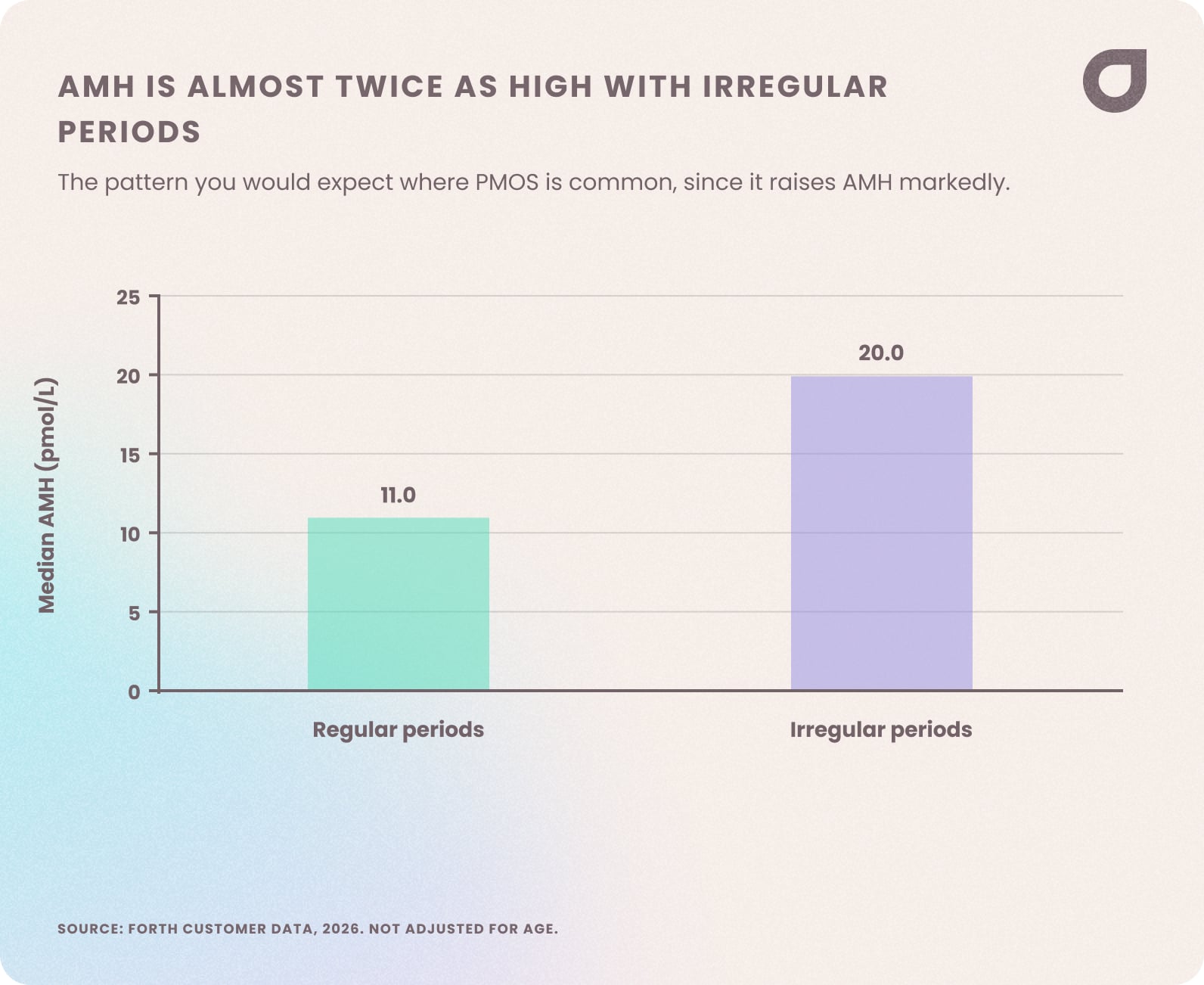
Irregular cycles came with a median AMH of 20.0 pmol/L against 11.0 for regular ones, the pattern you would expect where PCOS is common.
The studies most often cited as showing that AMH can be raised are small, mostly observational and generally measuring something adjacent to what people hope they are measuring. Vitamin D supplementation in women with diminished reserve has shown modest changes in some trials, though the effect is inconsistent and the mechanism unclear. Dietary studies have reported slower decline in AMH among women eating more dairy, which is an association rather than a demonstrated cause.
Taken together, the picture is that lifestyle changes can plausibly slow the rate of decline and support the health of the follicles you still have. No intervention has been shown to create new follicles, and any product marketed on that promise is overstating its evidence.
None of the following will rebuild your reserve, and none is worth doing for the sake of a number. What they will do is protect the follicles you still have and put you in better shape for whatever you decide to do next.
A high AMH usually means one of two things: you have a naturally generous ovarian reserve, or you have a larger than usual number of small follicles sitting in your ovaries and not maturing properly. The second scenario is the PMOS picture, and it is by far the most common explanation for a markedly raised result.
Less commonly, raised AMH can be seen with certain ovarian tumours, particularly granulosa cell tumours, which is one reason a very high result in a woman who does not fit the PMOS picture warrants proper clinical assessment rather than reassurance from a website.
In men, high AMH after puberty is unusual and can point to conditions such as persistent Müllerian duct syndrome, androgen insensitivity syndrome or testicular dysgenesis, all of which need specialist input.
High AMH does not cause symptoms directly. When symptoms are present, they belong to whatever is driving the raised level, which in practice usually means PMOS. Those symptoms typically include:
Plenty of women with high AMH have none of these and are simply well supplied.
The link between PMOS and high AMH makes sense once you know where the hormone comes from. In PMOS, the ovaries accumulate a large number of small antral follicles that begin to develop and then stall before maturing. Since it is precisely those small follicles that produce AMH, having many more of them produces a much higher blood level.
This is why AMH is increasingly discussed as a potential marker for PMOS, and why a high result alongside irregular periods and signs of raised androgens is a meaningful combination rather than a coincidence. Our data shows that association clearly, with women reporting irregular cycles carrying almost double the median AMH of those with regular ones.
AMH now has a formal place in that assessment, which is a genuine change from a few years ago. The 2023 international evidence-based guideline accepts a raised AMH in adults as an alternative to an ultrasound scan when establishing polycystic ovarian morphology, and it is explicitly not recommended for that purpose in adolescents, because multifollicular ovaries are common and entirely normal in the teenage years.
A high AMH is still not a diagnosis on its own. You need two of the three features: irregular or absent ovulation, clinical or biochemical signs of raised androgens, and polycystic ovarian morphology established by scan or by AMH. Where irregular cycles and raised androgens are both present, neither a scan nor an AMH is needed. Our PMOS blood test is designed to give you the biochemical part of that picture to take to your GP. If you want to understand the condition more fully first, our guide to PMOS symptoms and diagnosis is a good starting point.
There is no threshold above which pregnancy is likely and below which it is not. Women conceive across the whole AMH range, including well below the levels described as low. What actually predicts conception is age, ovulation, tubal health and sperm, none of which AMH measures.
Yes, and often quickly, because a large reserve usually means plenty of available eggs. The complication arises only when the high level reflects PMOS, in which case the barrier is unreliable ovulation rather than the AMH itself. If your periods are regular, a high AMH is not an obstacle.
No. AMH counts follicles, and counting tells you nothing about the chromosomal health of the eggs inside them. There is no blood test for egg quality, and the strongest determinant of it remains age. The confusion comes from IVF outcomes in women with PMOS, where very high AMH has been associated with less favourable results. The driver there appears to be the disordered ovulation and hormonal environment of PMOS rather than the AMH level itself. In a woman without PMOS, a high AMH is generally good news.
Clinics generally regard AMH above around 15 to 25 pmol/L as predicting a comfortable response to stimulation. NICE uses 5.4 pmol/L or below to flag a likely low response and above 25.0 pmol/L to flag a likely high one, the latter carrying an increased risk of ovarian hyperstimulation that clinics manage by adjusting the protocol. These are planning numbers rather than eligibility criteria.
Yes. Low AMH predicts that fewer eggs are likely to be collected each cycle, which may mean more cycles or a protocol designed for lower responders, but it does not rule you out. It also does not change the quality of the eggs collected, which is driven by your age, so a younger woman with low AMH often has a better outlook than the number alone suggests.
Not necessarily, though the two are related. A low result in your forties fits the perimenopausal picture, but it does not confirm you are in perimenopause and a normal result does not rule it out. Perimenopause is identified from symptoms and cycle changes rather than a single hormone value. Our perimenopause test looks at AMH alongside the other markers that shift during it.
It can be a signal, and one of the better ones we have, but it is not a prediction. Women with lower AMH for their age do tend to reach menopause somewhat earlier, though the margin of error around any individual estimate is too wide for a responsible clinician to give you a date. A low result before 40 alongside changing periods is worth investigating properly, since primary ovarian insufficiency benefits from being found early.
Research has used thresholds around 8 pmol/L to flag significantly reduced ovarian function, with values far lower than that in the final year or two before periods stop. A systematic review concluded that AMH is useful directionally but cannot narrow the timing to a clinically useful window. Menopause is confirmed by twelve months without a period, and AMH is not used to diagnose it.
AMH does not cause miscarriage, though associations have been found at both ends of the range. One study of naturally conceived pregnancies in women aged 30 to 44 found that those at or below 0.4 ng/mL miscarried at roughly twice the rate of women at 1 ng/mL or more. A 2022 study of first egg retrievals found women under 35 with high AMH at significant risk of early miscarriage compared with those mid-range. Both point to AMH reflecting the underlying ovarian environment rather than acting as a cause.
Possibly, though the evidence is thinner than the confident claims online suggest. One study of women being investigated for infertility found lower serum AMH in those under greater psychological stress, but separating cause from effect is difficult when fertility difficulty is itself stressful. If stress is a persistent feature for you, Cortisol (9am) alongside your reproductive hormones may tell you more.
Yes, in two different senses. Over years it declines steadily, and that gradual fall is the change that means something. Over shorter periods, small movements happen for less interesting reasons: assay differences between laboratories, sample handling, hormonal contraception and ordinary biological variation, which studies measuring two samples from the same woman have put at around 10%. A move of a point or two between tests is usually noise. A clear drop across several years is a trend.
Yes, and our own results show it: finger-prick samples returned a median of 11.7 pmol/L against 11.6 pmol/L for samples taken by a phlebotomist, a difference that falls below 1% once adjusted for age. The analysis is identical whichever way the blood arrived, so what matters is sample quality, laboratory accreditation and whether a clinician reviews the result. If you would rather not collect the sample yourself, you can book a nurse appointment at a clinic instead.
Collecting the sample takes a few minutes. Once it reaches our laboratory, results are usually available within two working days, and you will see your number, the reference range for your age and an explanation of what it means for you.
All these tests include Anti-Müllerian Hormone. Select the test that suits your personal needs.
Our AMH blood test checks your ovarian reserve. Useful for women going through IVF treatment.
£99
AutoDraw

Whether you're thinking of trying for a baby or are struggling to conceive, we're here to help with our fertility test.
£144
Certified for quality & security

